
Leave the farm for a week, and come home to every animal fed, watered, and safe.
How to leave the farm for a week is the leave-ready homestead, layer by layer, with what each piece costs. It's the order I plan to build it in on our own farm.
- Format
- Web and PDF
- Pages
- 11
- Sources
- 30, linked
- Cost
- Free
- Checked
- Oct 2026

Get the free guide
Check your inbox
It has your guide, and it points you to our other free guides. It comes from Venturopoly Farms. If it isn't there soon, look in spam or promotions, and move it to your inbox so the next ones land there too.
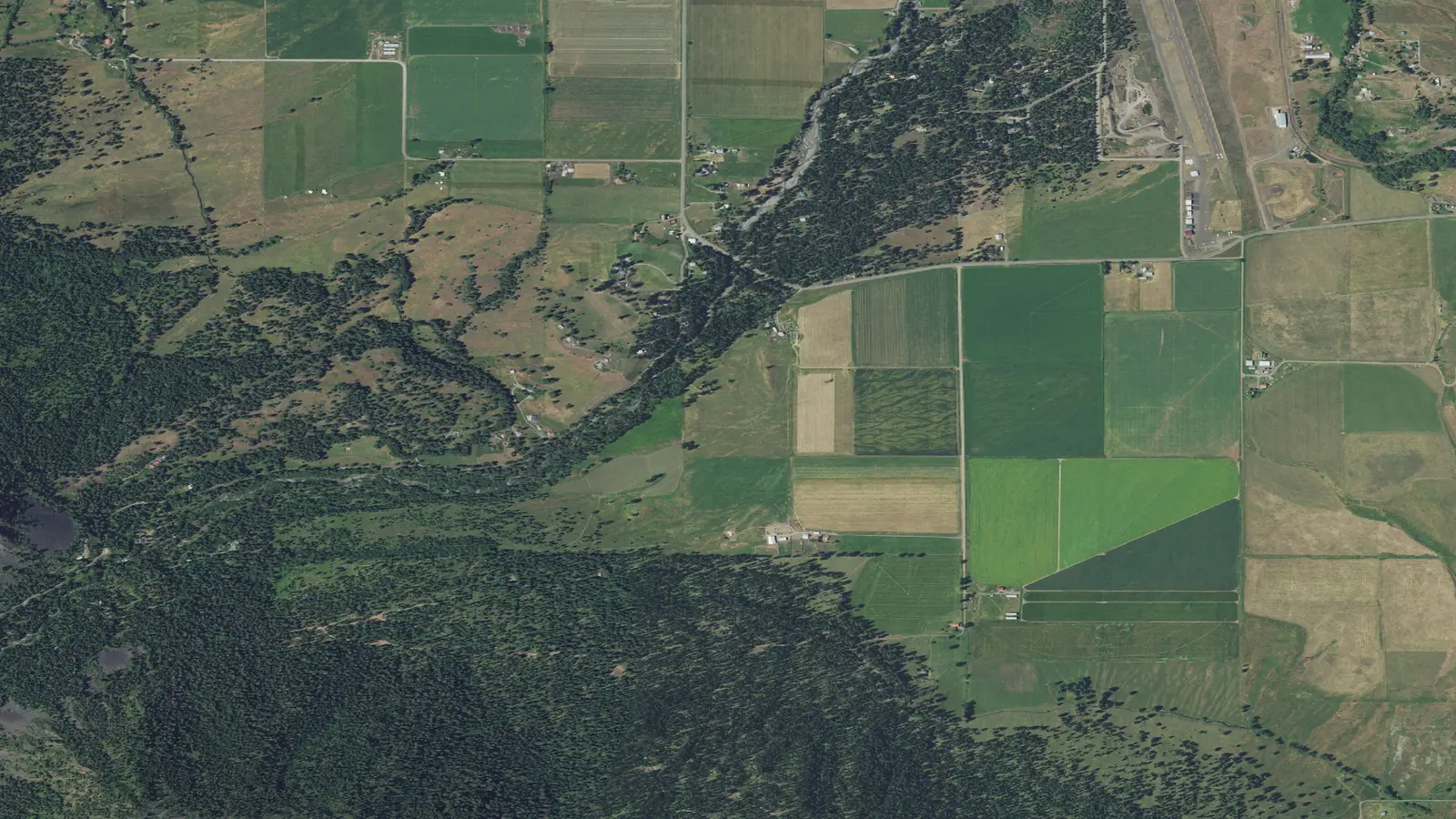
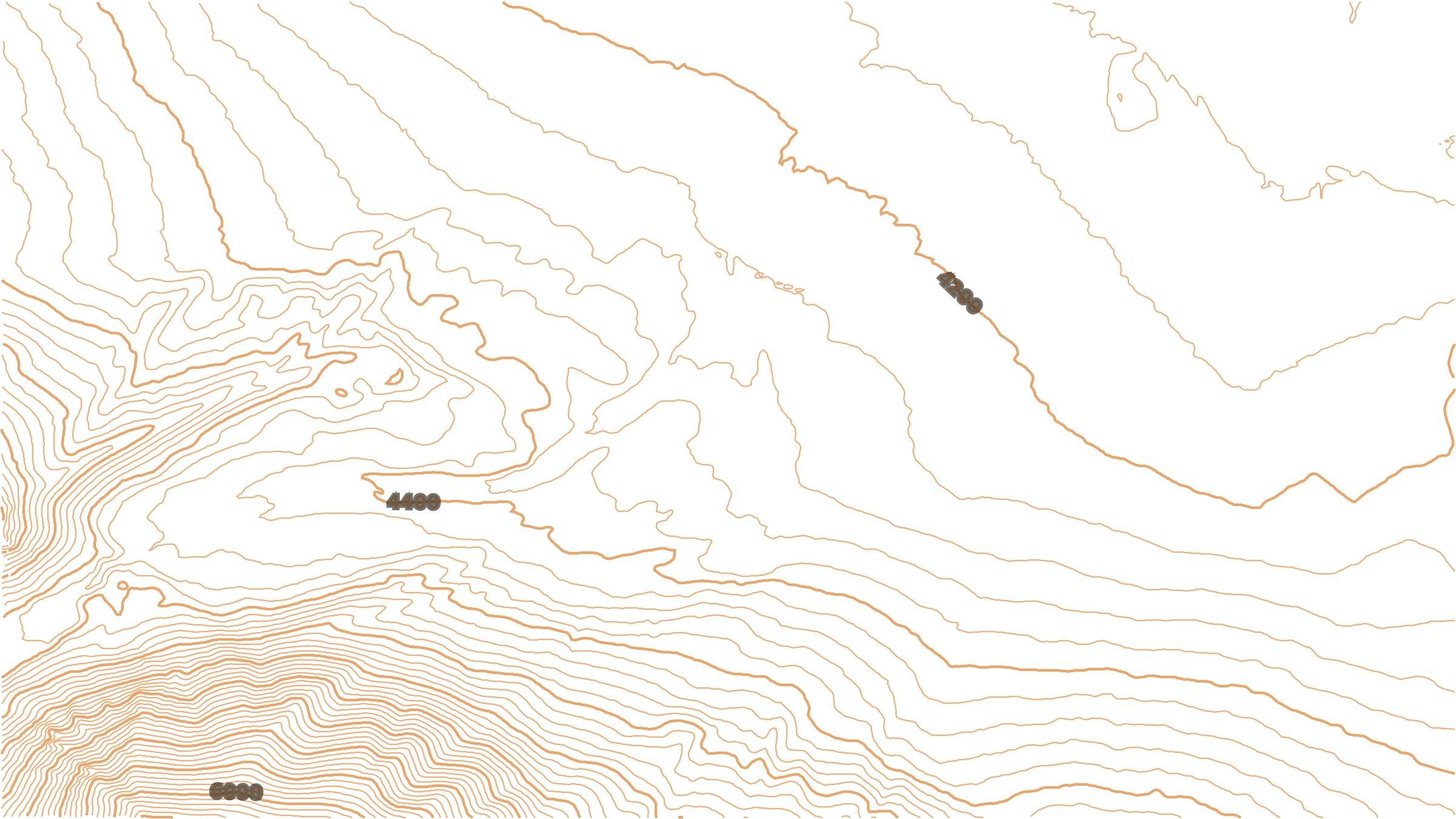
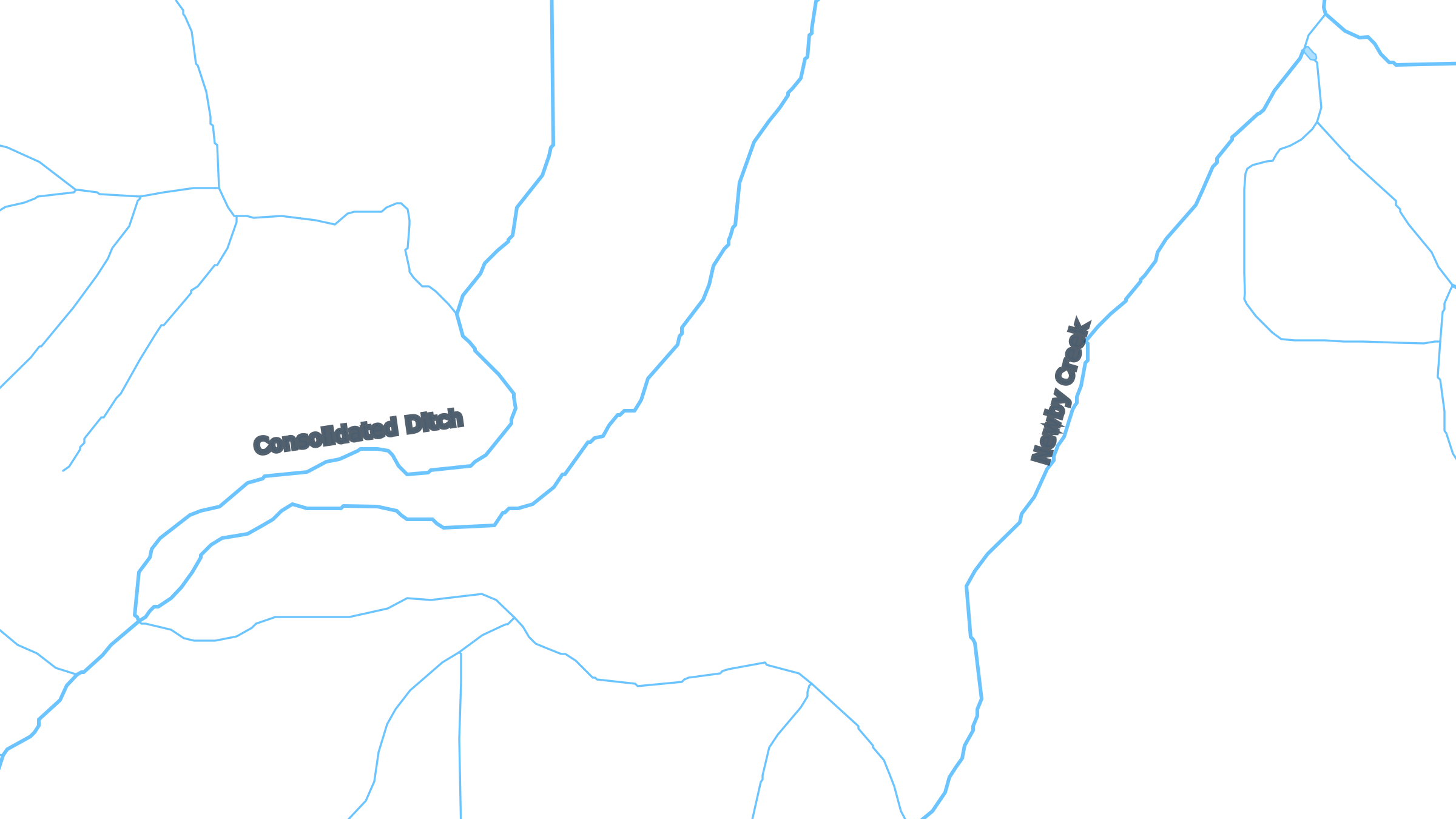
Map layers. Each button shows or hides its layer.
Why I wrote it
I've farmed in British Columbia, Oregon, Cambodia, Malaysia, Mexico, and Costa Rica. No matter where it was, the animals needed somebody there, every day.
Now my family is moving back to a farm in Oregon, with two kids under 2. Before we take on animals again, I wanted a real answer to the question a lot of people ask before they start: can we still leave for a week? The Prairie Homestead calls it one of the most common worries from people starting out.
It can be done, if you build for it from the start. You stack four layers, each one covering the one below: water and food that keep going with no power, chores that run themselves, alerts when something breaks, and a person who can get there. The first layer is the cheapest, and it needs no power at all.
This guide is what I found, with what each piece costs, in the order I plan to build it on our farm.
What you'll find in it
- Part 1 Why no single layer is enough: automation with no alerts can fail and nobody knows, and alerts with nobody nearby only let you watch.
- Part 2 Feeders and waterers that keep working with no power and no internet, and how long each one lasts.
- Part 2 The rule that keeps a trip from ending early: two water sources for every animal, one of them by gravity.
- Part 2 How to keep a garden alive through a week away with ollas, wicking beds, and drip under heavy mulch.
- Part 3 Why many budget coop doors can't be reached from a trip, and what to buy instead.
- Part 3 Virtual fencing for goats, sheep, and cattle: which collars cover which animals, what they cost, and why you still keep a real fence.
- Part 4 The four alerts that matter: is the door shut, is there water, is the fence on, and is anything hunting the birds.
- Part 4 Long-range sensors that report from many acres to one gateway, and how to check whether a public one already reaches you.
- Part 5 Farm sitters, sitting sites with members in more than 130 countries, volunteers, and neighbor swaps, and how to help any sitter do it well.
- Part 5 A sitter manual that answers questions at 2 a.m. while you're on a plane.
- Part 6 The choices you make once that make every trip easier: timing, milking, perennials, and backups.
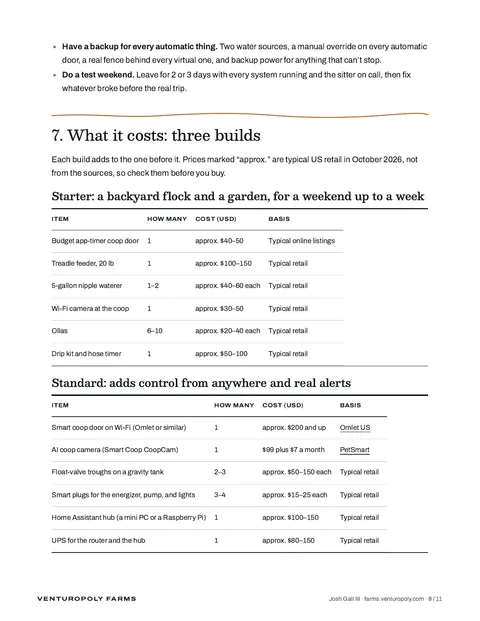
- Part 7 3 builds, item by item, in US dollars: a starter for a backyard flock, a standard you can run from anywhere, and a full remote setup for several acres.
- Part 8 The build order, and the checklist to run the day before you leave.
A look inside
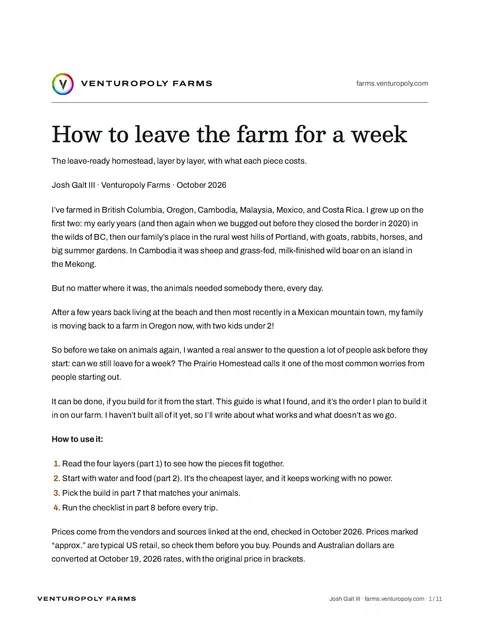
Three of the 11 pages, as they print. The web version has the same text, with every source linked.
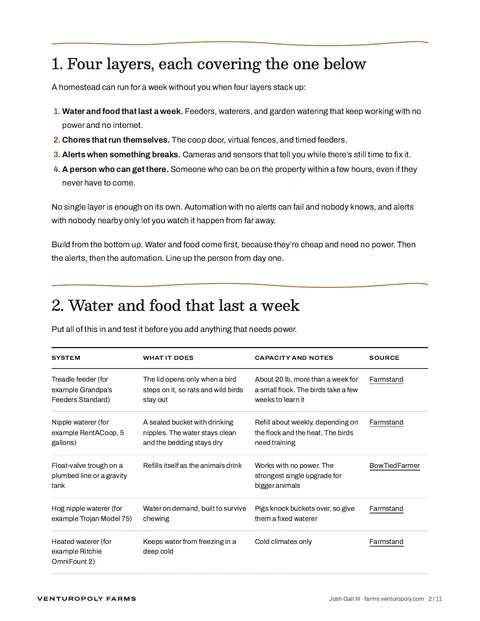
From the guide: four layers
A homestead can run for a week without you when four layers stack up:
- Water and food that last a week. Feeders, waterers, and garden watering that keep working with no power and no internet.
- Chores that run themselves. The coop door, virtual fences, and timed feeders.
- Alerts when something breaks. Cameras and sensors that tell you while there's still time to fix it.
- A person who can get there. Someone who can be on the property within a few hours, even if they never have to come.
No single layer is enough on its own. Automation with no alerts can fail and nobody knows, and alerts with nobody nearby only let you watch it happen from far away.
Build from the bottom up. Water and food come first, because they're cheap and need no power. Then the alerts, then the automation. Line up the person from day one.
Before every trip
The checklist from the end of the guide. Run it the day before you leave.
- Every feeder is full, and every animal has two water sources
- The coop door opens and closes from your phone
- The cameras are online, and the night view works
- The fence and water alerts work, tested by setting them off on purpose
- The coops and pens are mucked out
- The garden is deep-watered, the ollas are full, and the drip timer is set
- The sitter has walked through every chore with you in person
- The sitter manual has this trip's notes in it
- The emergency neighbor and the vet know you're away
- The backup power and the backup internet both work
Who it's for
Anyone with animals or a garden who wants to be able to leave: a backyard flock, a few goats, or a herd on several acres. Read it before you buy a farm, too. Some of it comes with the land, like water that runs downhill to the troughs and a phone signal at the barn, and it costs far more to add later.
What it isn't
It isn't a product pitch. There are no affiliate links and no sponsors, and V-Farms gets nothing from any product it names. The prices come from the vendors and the sources at the end.

Who wrote it
I'm Josh Galt III. I've farmed in British Columbia, Oregon, Cambodia, Malaysia, Mexico, and Costa Rica: goats, rabbits, and horses on our family's place in the west hills of Portland, sheep and grass-fed wild boar on an island in the Mekong, and a black soldier fly farm in Malaysia.
This year I went through about 1,100 farm listings for my own family's move back to Oregon. V-Farms is that search, written up: the best small grazing farms and homesteads I find, for sale, for lease, and caretaker deals.
V-Farms takes no money from sellers, developers, or brokers, and no commissions. Readers pay for the list, and that's all.
How it's sourced
The guide's prices and figures come from 30 sources, linked at the end: the vendors, farm-sitting sites, government farm agencies in Australia and Wales, the FAO, university extension, and the farm press. Prices marked "approx." are typical US retail, so check them before you buy.
Checked October 2026. Pounds and Australian dollars are converted at October 19, 2026 rates.
Before you sign up
- It's free
- No card and no trial. The guide is free for an email, and so are our other 2 guides.
- What you get
- The guide comes in the first email, as a web page and a PDF you can print. The same email points you to our other free guides. After that comes the free V-Farms weekly email.
- Your address
- We never sell it or share it. Every email has a one-click unsubscribe.
- One account
- Your email is also your V-Farms account. Sign in with a code any time to get the guides again.
- Who pays us
- V-Farms takes no money from sellers, developers, or brokers, and no commissions. Readers pay for the list, and that's all.
Get the free guide
How to leave the farm for a week, as a web page and an 11-page PDF: the four layers, three builds with prices, and the checklist for the day before you go.
P.S. I haven't built all of this yet. I'm building it on our farm in this order, and I'll write about what works and what doesn't as we go.
Josh Galt III
Check your inbox
It has your guide, and it points you to our other free guides. It comes from Venturopoly Farms. If it isn't there soon, look in spam or promotions, and move it to your inbox so the next ones land there too.