
Most good farms fail on something simple. Find it before you drive out.
What a self-sufficient farm needs, anywhere is the checklist I used on about 1,100 farm listings across 35 US states. It works on any farm you look at, for buying or leasing, at home or abroad.
- Format
- Web and PDF
- Pages
- 17
- Sources
- 47, linked
- Cost
- Free
- Checked
- Oct 2026
Get the free report
Check your inbox
It has your report, and it points you to our other free guides. It comes from Venturopoly Farms. If it isn't there soon, look in spam or promotions, and move it to your inbox so the next ones land there too.
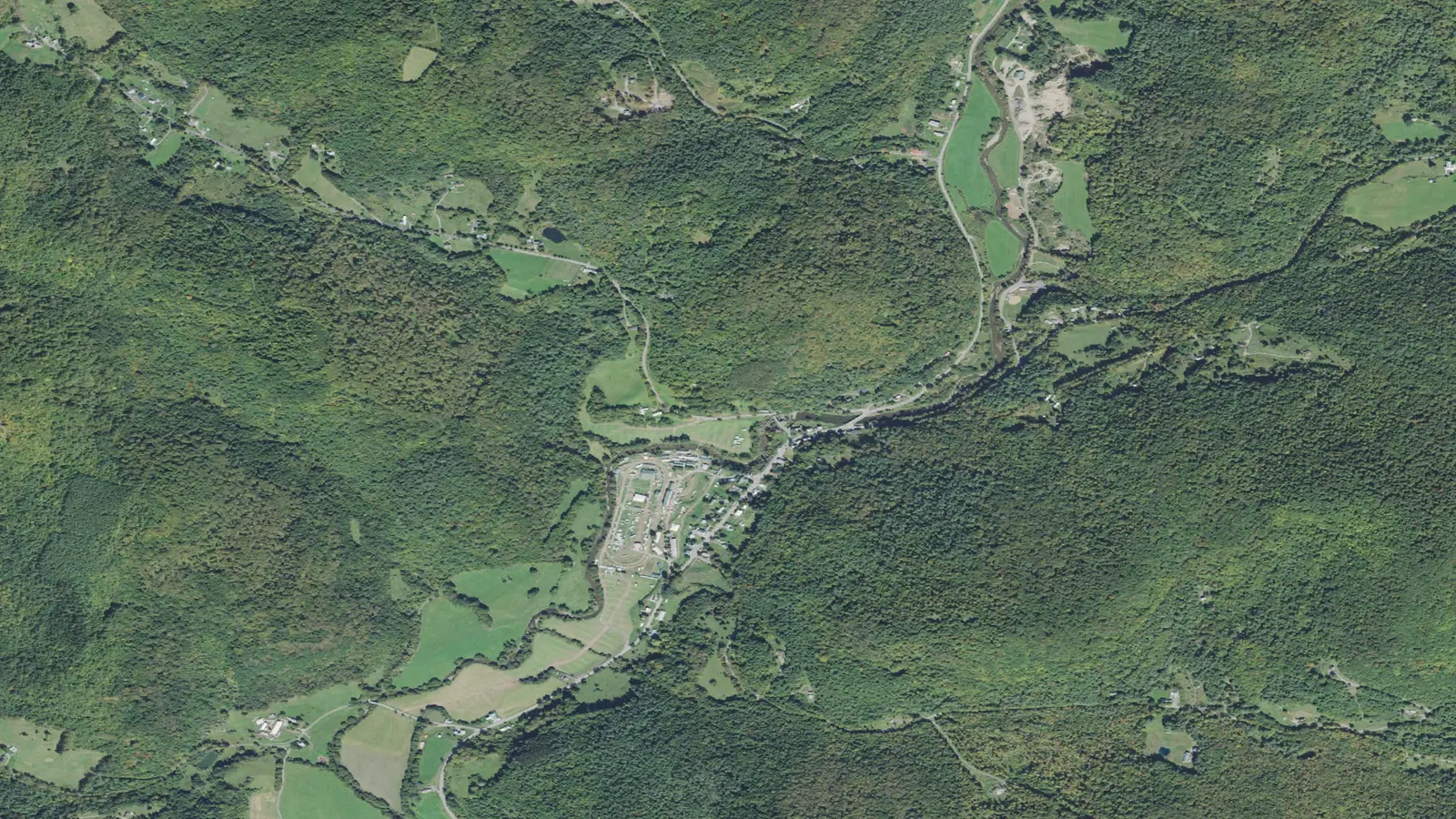
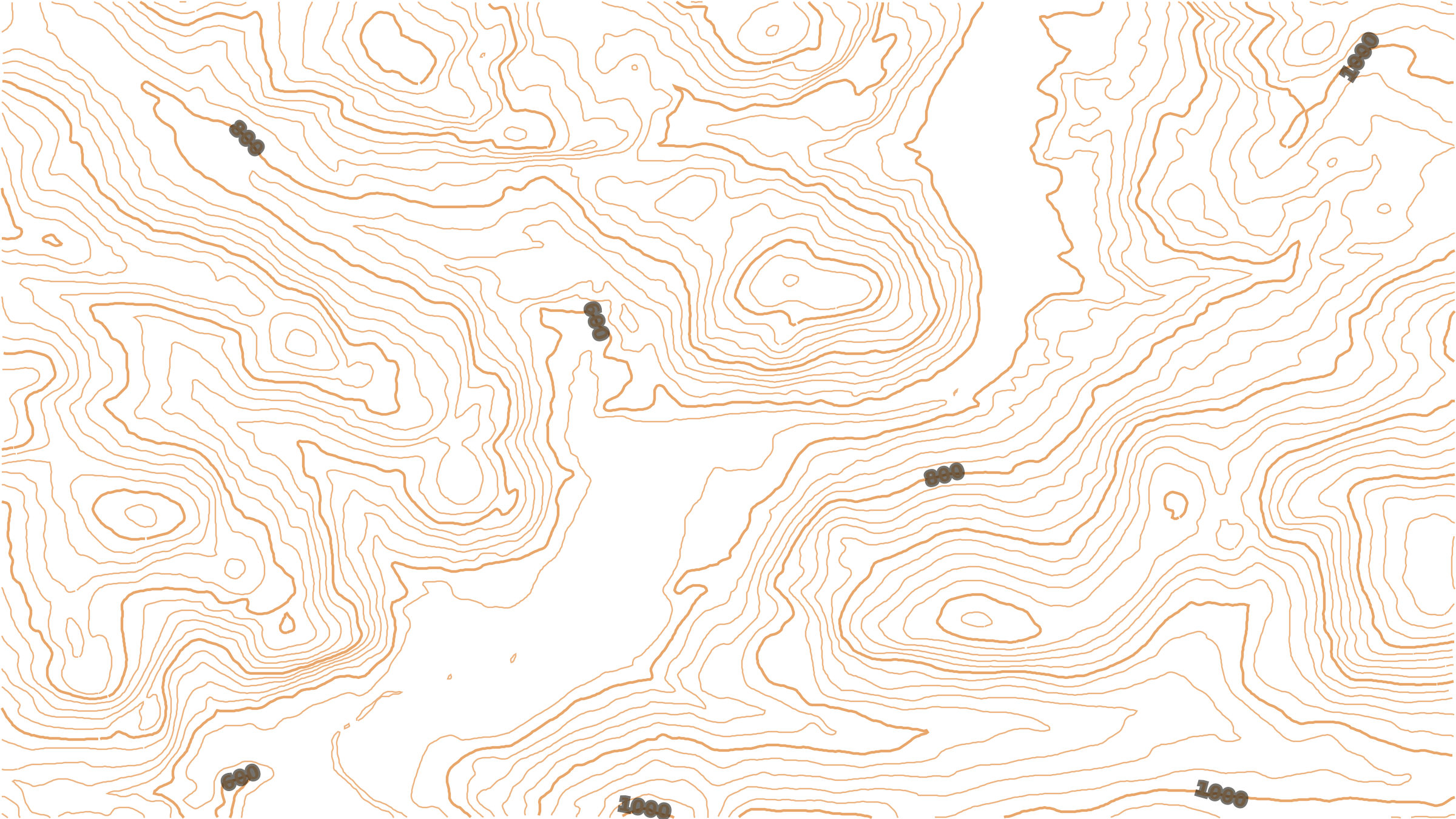
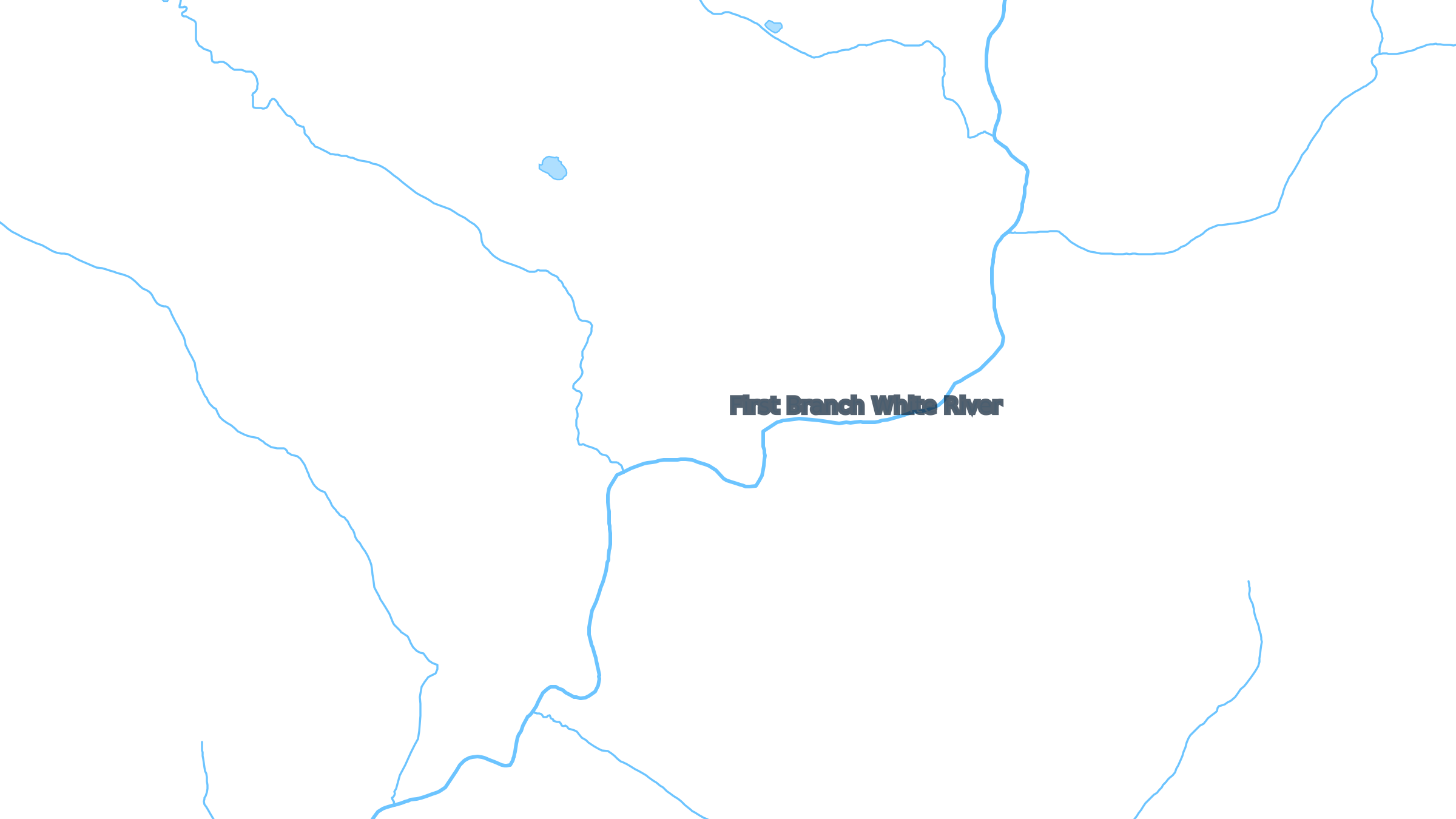
Map layers. Each button shows or hides its layer.
Why I wrote it down
After nearly 2 decades living abroad, I'm moving my family back to a farm in Oregon, where I have my roots. To find it, I went through about 1,100 farm listings across 35 US states.
Most of the good ones failed on something simple. Usually it was the house. Sometimes it was the water. Now and then it was something nobody mentions until you ask about it directly.
You can't see those things in the photos. Some you can check from your desk with free public maps. The rest come down to a short list of questions for the owner. Each one you answer before you drive out saves a wasted trip, and each one you answer before you sign keeps you from buying a mistake.
This report is the checklist I ended up using to narrow down the list. It starts with what you want the land to do, because that decides which checks count most. Then it goes through grass, water, power, heat, the house, the hazards, and the title, one at a time: what good looks like, what to ask the owner, and what you can check yourself.
It works on any farm you look at, ours or not, for sale or for lease, in the US or abroad.
What you'll find in it
- Part 1 Which checks count most for what you want the land to do: a full-time home, a farm that has to pay, a guest farm, several households, or a place that sits empty part of the year.
- Part 2 Why acres tell you very little, and the number to ask for instead: animal unit months a year.
- Part 2 How to read a farm's grass on the NRCS Web Soil Survey before you visit, and what to do outside the US.
- Part 3 Why the well isn't the whole water question. In much of the US West a water right can be sold off the land, and in Oregon 5 unused years can forfeit it.
- Part 3 Why a farm with barns and no house may never be allowed one, and the call to make before you fall in love.
- Part 3 Which septic systems keep working with no power, and what makes a house hold up to fire and flood.
- Part 3 The hazard almost nobody checks: whether the farm sits in a dam's inundation zone.
- Part 4 7 quick tests you can run on any listing, from the ordinary week to the grid-down month.
- Part 5 What fails first on cold, dry, wet, tropical, mountain, and island farms.
- Part 6 Why residency comes before land abroad, and what Costa Rica did to its legal residents in 2020.
- Part 6 Which countries give residency for buying property, as of October 2026, and which one stopped.
- Part 7 11 red flags that should stop you, or at least slow you down.
- Part 8 The free maps for soil, rain, flood, fire, dams, earthquakes, internet, and meat processors, with links.
A look inside
Three of the 17 pages, as they print. The web version has the same text, with every source linked.
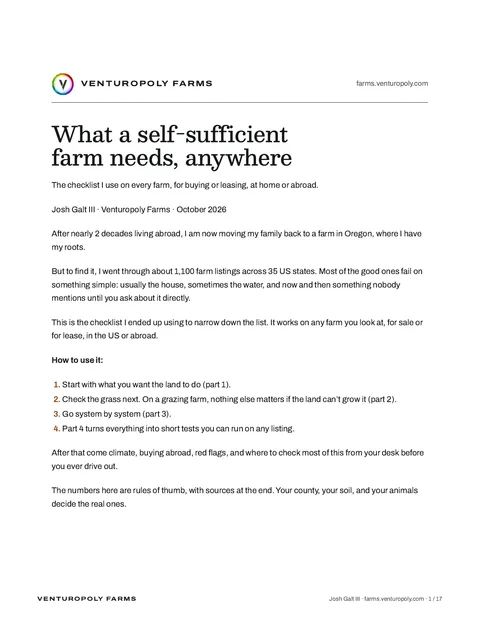
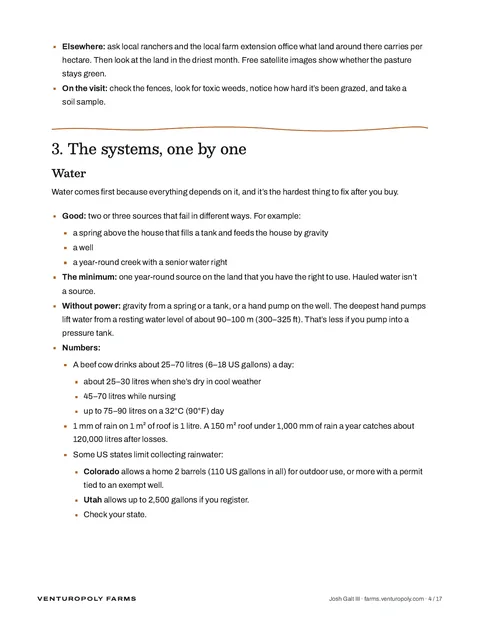
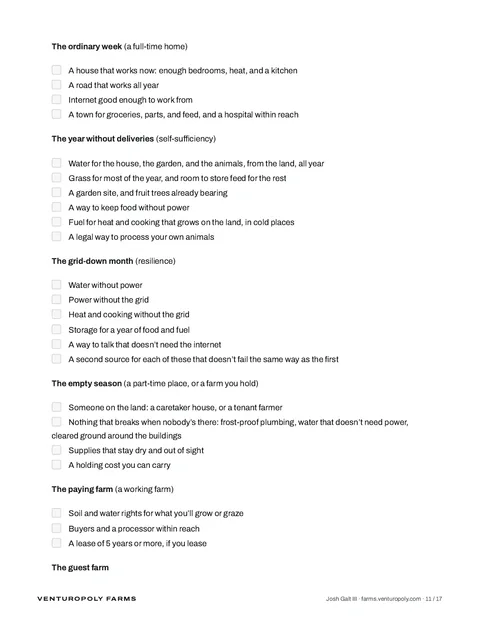
From the report: grass comes first
On a grazing farm, grass is the engine. If the land can't grow it, you don't get the animal units, and everything after that gets expensive, because you're buying, hauling, and storing hay instead.
Count animal units, not acres. One animal unit is a 1,000 lb (454 kg) cow with a calf up to 6 months old, eating about 26 lb of dry forage a day. Ten acres in western Oregon can carry more animals than a hundred in Nevada, so acres alone tell you very little.
In the US, the NRCS Web Soil Survey rates pasture soils in animal unit months per acre. Draw the parcel on the map and read the number. Elsewhere, ask local ranchers what land around there carries per hectare, and look at the land in its driest month.
Get the free reportWho it's for
Anyone weighing a farm to buy or lease, at home or abroad: a place to live all year, a farm that has to pay, a guest farm, land shared by several households, or a farm you'll hold while someone else lives on it. It works just as well on a farm you already own.
What it isn't
It isn't written for cropland investing, or for hunting ground with no house. It isn't a sales pitch either: V-Farms doesn't sell farms, broker deals, or take a cut of anything.
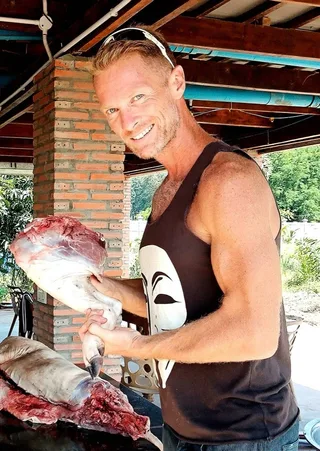
Who wrote it
I'm Josh Galt III. I've farmed in British Columbia, Oregon, Cambodia, Malaysia, Mexico, and Costa Rica: goats, rabbits, and horses on our family's place in the west hills of Portland, sheep and grass-fed wild boar on an island in the Mekong, and a black soldier fly farm in Malaysia.
This year I went through about 1,100 farm listings for my own family's move back to Oregon. V-Farms is that search, written up: the best small grazing farms and homesteads I find, for sale, for lease, and caretaker deals.
V-Farms takes no money from sellers, developers, or brokers, and no commissions. Readers pay for the list, and that's all.
How it's sourced
The report's figures come from 47 sources, linked at the end: USDA, the EPA, state water agencies, university extension services, and government immigration offices among them. The numbers are rules of thumb. Your county, your soil, and your animals decide the real ones.
Checked October 2026. It's general information from our own research, not legal, tax, financial, or immigration advice.
Before you sign up
- It's free
- No card and no trial. The report is free for an email, and so are our other 2 guides.
- What you get
- The report comes in the first email, as a web page and a PDF you can print. The same email points you to our other free guides. After that comes the free V-Farms weekly email.
- Your address
- We never sell it or share it. Every email has a one-click unsubscribe.
- One account
- Your email is also your V-Farms account. Sign in with a code any time to get the guides again.
- Who pays us
- V-Farms takes no money from sellers, developers, or brokers, and no commissions. Readers pay for the list, and that's all.
Get the free report
The checklist I used on about 1,100 farm listings, as a web page and a 17-page PDF. Use it on the next farm you look at, ours or not.
P.S. If you're already looking at a farm, start with part 4. The quick tests take one listing at a time, and they show you which questions to ask the owner before you drive out.
Josh Galt III
Check your inbox
It has your report, and it points you to our other free guides. It comes from Venturopoly Farms. If it isn't there soon, look in spam or promotions, and move it to your inbox so the next ones land there too.